Let's Keep the Conversation Going!
Click below. The prepared email will be copied automatically.
Dear Mr. Meyers and Other ASHA Leadership,
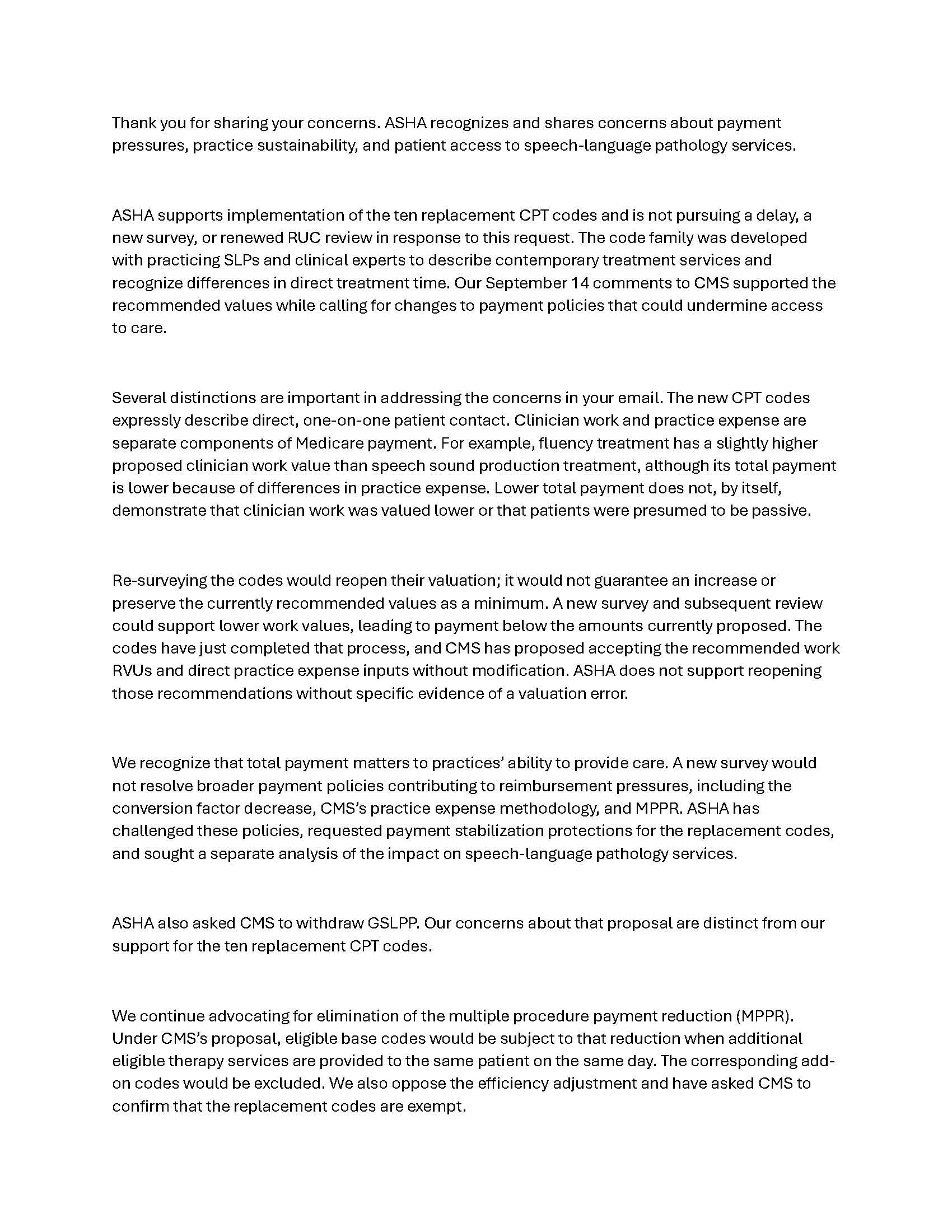
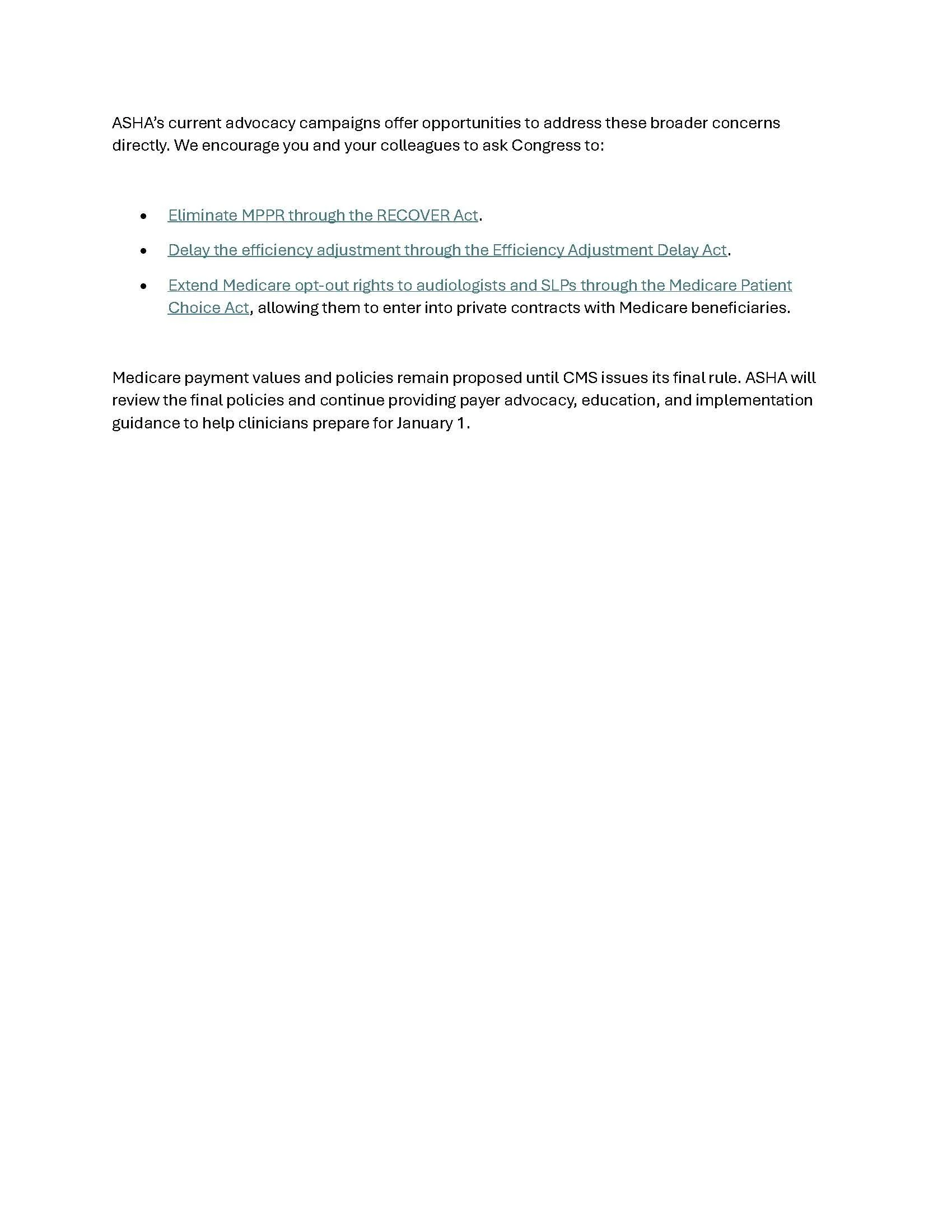
Thank you for your response. I appreciate ASHA’s opposition to the proposed G-SLPP code and its advocacy concerning MPPR and other Medicare payment policies. However, my principal request remains unanswered in substance: I asked ASHA to formally request that CMS delay implementation of CPT codes 92654-92663. Your reply confirms that ASHA is not pursuing a delay and does not support reopening those recommendations “without evidence of a valuation error.”
I support accurate modernization of SLP coding, if needed. That support should not be conflated with endorsement of the impending implementation of recommended valuations. Legislative efforts to change MPPR and other policies may be important, but without the NCCI edits one cannot predict future effects, and any relief from legislative efforts will not be actualized before the codes are implemented.
To reiterate the evidence of “valuation error,” I reference my original email:
The Centers for Medicare & Medicaid Services (CMS) has proposed a fundamentally flawed valuation structure for the new family of domain-specific, timed speech-language pathology (SLP) CPT codes designed to replace CPT 92507 (treatment of speech, language, voice, communication, and/or auditory processing disorder, individual). By selecting reference crosswalks that utilize highly unrelated, untimed diagnostic codes where the patient is a passive participant or entirely absent, severe rank order anomalies were introduced to the code family.
Any SLP procedure formerly under the scope of CPT 92507 cannot exist without the dynamic, active, face-to-face interaction between the therapist and the patient and is inherently human-centric. To anchor a highly intensive face-to-face session against a benchmark where the patient’s physical presence is secondary—or completely unnecessary—is a structural failure that devalues direct clinical care.
The reliance on these passive reference codes to establish the value of the codes replacing CPT 92507 directly contradicts the guidelines of the American Medical Association (AMA) Relative Value Scale Update Committee (RUC) and creates systemic rank order anomalies.
Comparator Codes Used in Code Valuation
| New SLP Code | Treatment | Comparator Codes Used in Code Valuation |
|---|---|---|
| 92654 | Fluency (30 min) | 92584; 97550 |
| 92656 | Speech sound (30 min) | 92584; 92651; 97550 |
| 92658 | Language (30 min) | 92584; 97550 |
| 92660 | Speech sound and language (30 min) | 92584; 92651; 97550 |
| 92662 | Voice (30 min) | 92584; 92651; 97550 |
CPT 92584 and 92651 concern diagnostic untimed audiology testing, while CPT 97550 describes caregiver training without the patient present. These services are materially different from continuous, individualized SLP treatment.
The adopted recommendations:
- Violate the Separation of Procedure and Diagnosis: In other Qualified Healthcare Professional (QHP) outpatient disciplines, the CPT code dictates what therapeutic modality the professional performed (e.g., therapeutic exercise, neuromuscular reeducation, or cognitive rehabilitation), while the ICD-10 code specifies the anatomy or disorder. Forcing the diagnosis into the procedural CPT code creates an unnecessary, redundant coding structure that uniquely disadvantages speech-language pathology providers and the patients we serve.
- Contradict Peer Physical/Occupational Therapy and Other Coding Models: Physical therapists do not have separate timed CPT codes for “knee exercises” versus “shoulder exercises.” Occupational therapists bill generic timed codes like Therapeutic Activity (97530), regardless of whether the target condition is a stroke or a hand injury. Forcing SLPs to choose between 92656 (speech sound) and 92658 (language) based on the body system or impairment area breaks standard outpatient conventions.
- Impose Diagnostic Discrimination on Provider Time: By tying the value of a timed block of direct provider care to a specific diagnosis, the system asserts that 30 minutes of an SLP’s cognitive or clinical labor is inherently worth less if spent on language ($49.92), voice ($54.84), fluency ($54.55), or speech sound ($66.01) versus speech-language ($71.59). This is a severe coding irregularity; an SLP’s time and operational overhead do not fluctuate based on the specific disorder being treated in a context in which the practice expense is identical.
The 2027 speech-language pathology replacement code structure introduces a fundamental architectural inconsistency that deviates from established healthcare coding standards for outpatient services delivered by QHPs.
Standard healthcare reimbursement models maintain a strict division between the procedure rendered (CPT code) and the patient’s impairment (ICD-10-CM code). In peer outpatient rehabilitation disciplines like physical and occupational therapy, behavioral health timed codes reflect universal therapeutic modalities or the practitioner’s direct service time, completely independent of the underlying diagnosis.
In key takeaways, ASHA published “that CMS accepted ASHA’s recommended RVUs and direct practice expense inputs for all 10 new SLP treatment codes.” It is assumed that ASHA, as a specialty society, also recommended comparator codes. Therefore, ASHA has an inherent obligation to remedy.
You indicate that:
“Medicare payment values and policies remain proposed until CMS issues its final rule.”
It is because the Medicare payment values and policies proposed are not finalized, ASHA has the opportunity and obligation to draw attention to:
- Mismatched intensity
- Practice expense distortions
- Violation of the “Like Services Principle”
You also stated:
“We recognize that total payment matters to practices’ ability to provide care. A new survey would not resolve broader payment policies contributing to reimbursement pressures, including the conversion factor decrease, CMS’s practice expense methodology, and MPPR. ASHA has challenged these policies, requested payment stabilization protections for the replacement codes, and sought a separate analysis of the impact on speech-language pathology services.”
I can, with mathematical certainty, assure that if reference codes were selected that appropriately represent the required intensity of work for a continuous 30-minute, one-on-one clinical treatment incorporating real-time reasoning, behavioral management, and expert intervention, and are properly benchmarked, the resulting value would be higher than codes that can be executed by technicians or that can be completed without a patient present. The use of inappropriate reference codes has suppressed the work RVUs.
ASHA’s participation in the development of and recommendation of the proposed fee framework and valuation creates a strong position for requesting a delay in implementation on behalf of its membership who are QHPs and clinical experts in speech-language pathology.
Accordingly, we request that ASHA:
- Ask CMS to delay implementation of CPT codes 92654-92663 while valuation and implementation concerns are evaluated;
- Provide a written explanation of its decision not to seek delay if ASHA maintains that position; and
- Identify the evidence and process that could trigger a corrective valuation review, including possible RUC refinement and re-survey, and clarify whether the concerns identified above constitute adequate evidence of valuation error.
I look forward to your response.
Sincerely,
Enter name and credentials
This process works exactly like the first ASHA email:
Press the Respond to ASHA Now button.
The email will be copied to your clipboard
Choose your default email server. The email addresses will populate automatically.
Press Paste or Control + V to paste the body of the email.
Change your name and credentials at the bottom of the email and press Send!
Visit the other pages of our site for more information and advocacy opportunities, and please complete our poll on the home page so we can track our impact.
Just in case, you email doesn’t automatically populate:
reimbursement@asha.org, governance@asha.org, swarren@asha.org, GAPP@asha.org, itennakoon@asha.org, actioncenter@asha.org, jmeyers@asha.org, nswanson@asha.org